
FUE Hair Replacement for Natural-Looking Hair Restoration
FUE hair replacement is an advanced hair restoration approach in which individual follicular units are extracted from a suitable donor area and placed strategically into areas affected by hair loss. At Radiant Clinics, Dr. Vikas Panthri follows a precision-focused approach to donor assessment, hairline design, graft extraction and placement, with treatment tailored to each patient’s hair-loss pattern and restoration goals.
5,700+ Procedures Performed
16+ Years of Experience
Doctor-Led Surgery
Delhi & Mumbai
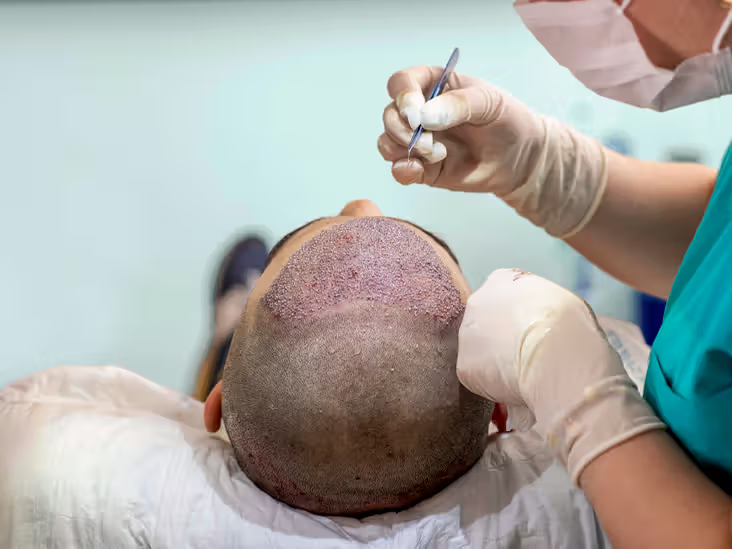
Follicular Unit Extraction (FUE)
Follicular Unit Extraction (FUE) is an advanced hair restoration procedure in which individual follicular units are extracted from the donor area—typically the back and sides of the scalp—and transplanted into thinning or bald regions.
Unlike older techniques that remove a strip of scalp, FUE involves extracting individual follicular units, resulting in minimal visible scarring and faster recovery.
The procedure is widely used for:
- Receding hairlines
- Male pattern baldness
- Crown baldness
- Frontal thinning
- Density enhancement
- Hairline reconstruction
Who Is A Good Candidate For FUE?
The best candidates typically:
- Have stable hair loss
- Possess adequate donor density
- Have realistic expectations
- Are looking to restore permanently lost hair
- Are over 25 years of age
FUE may not be ideal if:
- Hair loss is progressing rapidly
- Donor supply is severely limited
- Diffuse unpatterned hair loss (DUPA) is present
- Significant scalp disease is active
Step 1: Hair Loss Assessment
Evaluation of:
- Hair loss stage
- Donor density
- Family history
Step 2: Hairline Planning
Designing a natural, age-appropriate hairline based on:
- Facial proportions
- Existing hair
- Future hair loss risk
Step 3: Follicular Unit Extraction
Healthy follicles are harvested individually from the donor area.
Step 4: Recipient Site Creation
Tiny recipient sites are created to control:
- Direction
- Angle
- Density
Why FUE Results Sometimes Look Unnatural
Many patients considering surgery worry:
The answer usually depends on planning rather than the technique itself.
Common causes of unnatural results include:
- Aggressive hairlines
- Incorrect angulation
- Poor density distribution
- Technician-led surgery
- Donor overharvesting
At Radiant Clinics, emphasis is placed on:
- Natural hairline design
- Proper whorl creation
- Donor preservation
- Long-term planning
FUE Recovery Timeline
A comprehensive overview of what to expect during your post-procedure transformation journey.
Mild redness
Tiny crusts
Return to routine activities
Temporary shedding phase
Early visible growth
Significant improvement
Final maturation and density
Why Some Patients Need PRP Instead Of FUE
Many patients are surprised to learn that surgery is not always the first recommendation. Patients with early thinning, active follicles, or diffuse hair loss may benefit more from PRP or GFC before considering surgery.
Why Choose Dr. Vikas Panthri?
5,700+ Procedures
A proven track record of successful transformations delivering consistent, natural-looking results.
16+ Years Experience
Deep clinical expertise in advanced trichology, hair restoration, and non-surgical therapies.
Former Trauma ICU Intensivist
Brings an elite level of medical safety, precision management, and critical care protocols to the surgical room.
ISHRS Member & Featured on AIR FM
Aligned with global hair restoration standards and recognized as a trusted medical authority in public media.
Doctor-Led Surgical Protocols
Every critical surgical step, design, and extraction is executed directly by the doctor, not left to technicians.
What Is the Price of FUE Hair Transplant?
The price of FUE hair transplant can vary considerably between patients. There is no single price that applies to every procedure because the treatment requirement depends on the extent and pattern of hair loss, the number of grafts required, donor-area characteristics and the complexity of the restoration.
At Radiant Clinics, the estimated treatment requirement is determined after assessing the patient’s hair and scalp. This allows the recommended procedure and expected cost to be discussed based on the individual’s requirements rather than relying on a standardised package.
Understanding the Cost of FUE Hair Transplant
The cost of FUE hair transplant depends on several factors beyond the number of grafts. Hairline reconstruction, the degree of thinning, donor-area availability, previous transplant procedures and the complexity of graft placement can all influence treatment planning.
A consultation with Dr. Vikas Panthri helps assess these factors before a treatment plan is developed. Patients can discuss their hair-loss concerns, expected graft requirements, procedure details and associated costs before deciding whether FUE is appropriate for them.