
PRP Hair Treatment For Hair Thinning & Early Hair Loss
PRP (Platelet-Rich Plasma) is a non-surgical hair restoration treatment that uses concentrated platelets and growth factors derived from your own blood to support weakened hair follicles.
It is commonly recommended for patients experiencing early hair thinning, increased shedding, reduced density, and progressive hair loss where follicles are still alive but underperforming.
What Is PRP Hair Treatment?
PRP stands for Platelet-Rich Plasma.
Your blood contains:
- Red Blood Cells
- White Blood Cells
- Platelets
- Plasma
Platelets naturally contain growth factors that help the body heal damaged tissue.
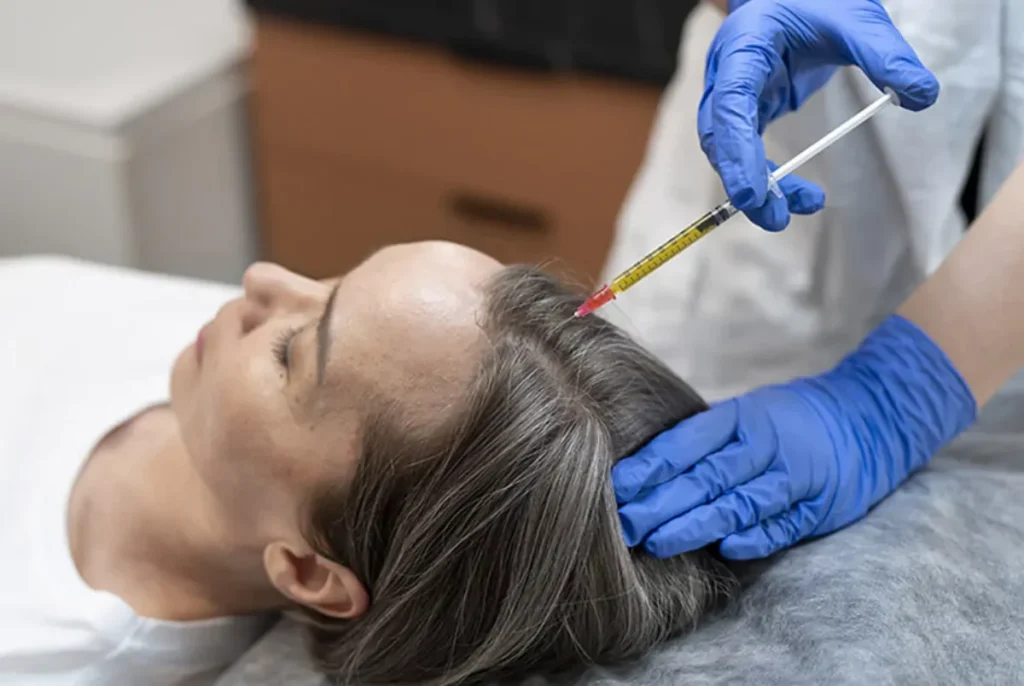
During PRP therapy, these platelets are concentrated and injected into areas of the scalp affected by thinning hair.
The objective is to improve the environment around existing follicles and support healthier hair growth cycles.
How PRP Is Performed
Blood Collection
A small amount of blood is drawn from your arm.
Centrifugation
The blood sample is processed using a centrifuge.
This separates:
The platelet-rich portion is isolated for treatment.
Scalp Preparation
The treatment area is cleaned and prepared.
PRP Injections
Concentrated PRP is injected into areas affected by thinning.
PRP Treatment for Hair Thinning
PRP treatment for hair thinning may be considered when there is existing hair in areas experiencing reduced density. It is particularly relevant to patients who want to explore a non-surgical approach to certain types of hair thinning.
The recommended treatment plan depends on individual factors, including the pattern and progression of hair loss, existing hair density and overall scalp condition. A consultation with Dr. Vikas Panthri helps determine whether PRP is suitable or whether another hair restoration approach may be more appropriate.
What Does PRP Actually Do?
PRP does not create new follicles.
Instead, it aims to support existing follicles by:
- Improving blood supply
- Enhancing follicular activity
- Supporting hair growth cycles
- Reducing miniaturization
- Improving hair thickness
Who Is A Good Candidate?
PRP may be suitable if you have:
- Early-stage hair loss
- Male pattern baldness
- Female pattern hair loss
- Hair thinning
- Excessive shedding
- Reduced density
Who Is Not A Good Candidate?
PRP is less effective when:
- Bald areas are completely smooth
- Follicles are permanently lost
- Advanced baldness is present
- Significant scarring exists
When Can Results Be Seen?
Reduction in shedding
Improvement in hair quality
Visible density enhancement
Maximum improvement
Results vary depending on follicular health and the severity of hair loss.